Concrete Leveling vs. Concrete Replacement: What Actually Makes Financial Sense?
My blunt take: if your slab is structurally sound, replacing it just because it looks rough is often burning money.
But, (and this is a big but), when the concrete is failing as concrete, leveling can turn into an expensive bandage. The “right” answer isn’t a slogan. It’s a decision about risk, time, and how long you need the fix to last.
One-line reality check:
Leveling usually wins the next 1, 10 years. Replacement often wins the next 10, 20.
Two fixes, two philosophies
Concrete leveling vs concrete replacement comes down to corrective lifting versus starting over. You keep the slab, and you restore grade by filling voids beneath it using either:
– a cementitious slurry (classic mudjacking), or
– polyurethane foam (modern, precise, fast)
Concrete replacement is demolition plus new construction: remove the bad slab, prep the base, form it, pour a new mix, finish it, cure it, and reopen it when the concrete’s ready.
Same goal, flat, safe, drainable surface. Totally different economics.
The “fast decision” test (it’s not complicated)
If you’re standing there staring at a tilted walkway or a dipped driveway, run this mental checklist:
– Is the slab mostly intact? (no widespread crumbling, no deep spalls, no broken panels)
– Is settlement the main problem? (voids, washout, bad compaction)
– Do you need it usable quickly? (business entrance, shared driveway, critical access)
If yes, leveling is usually the first move I’d price.
If you’re looking at structural breakup, large sections moving independently, rebar corrosion, or repeated heaving/settlement history? Replacement starts making more sense, even if you hate the upfront number.
Upfront cost: where the 30, 60% savings comes from
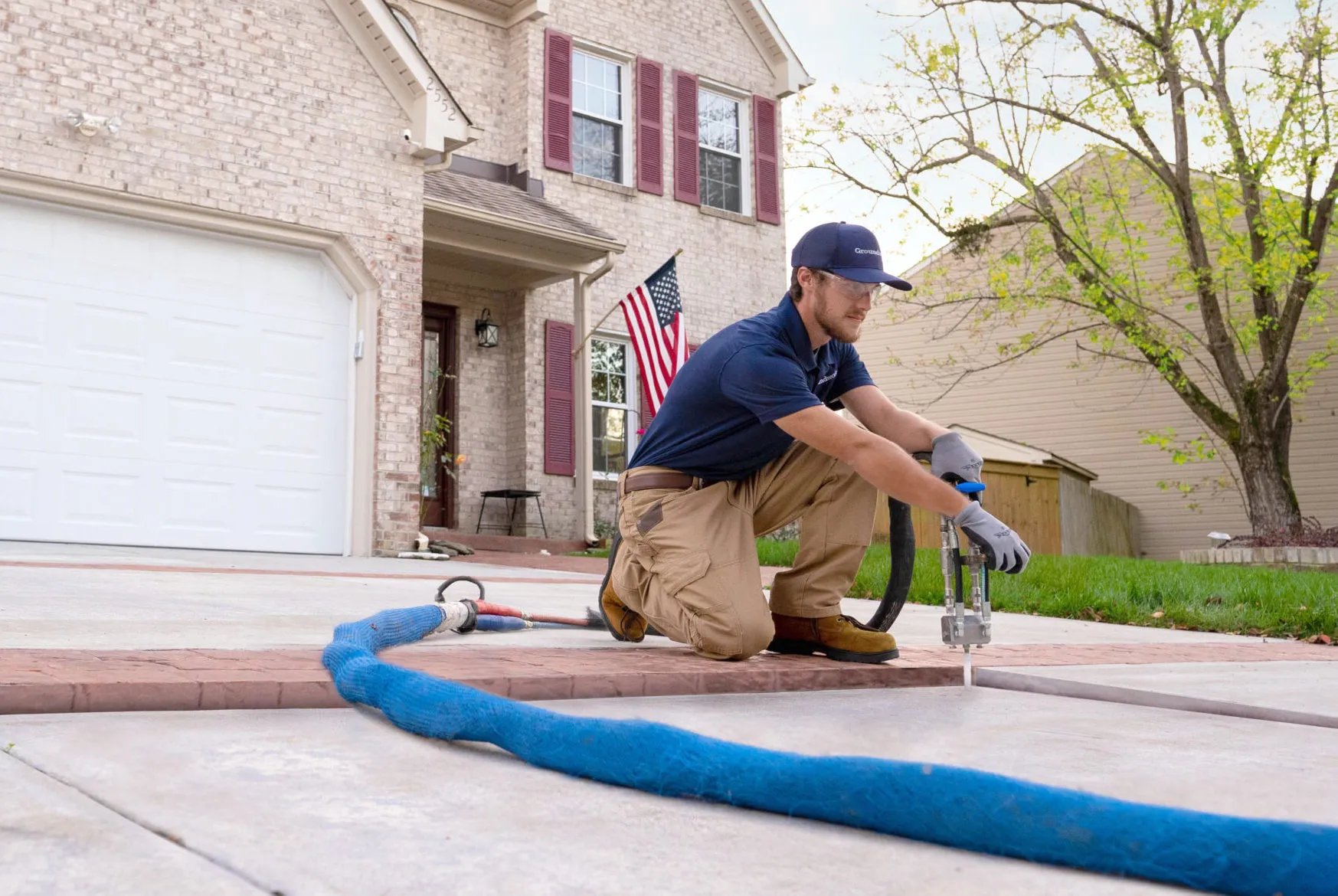
Leveling is cheaper for a boring reason: you’re not paying for a full demo-and-rebuild workflow.
Replacement stacks costs quickly:
– sawcutting/demo + haul-off
– disposal fees
– base rebuild/compaction
– formwork and reinforcement
– concrete delivery + finishing labor
– curing downtime (which is its own cost if access matters)
Leveling skips most of that. You drill small holes, inject material, dial in elevation, patch holes, and you’re typically back in service fast.
A specific data point, since people ask: according to HomeAdvisor’s cost data, concrete leveling/mudjacking commonly lands around $3, $6 per square foot, while replacement often runs $6, $14 per square foot depending on thickness, access, and finish complexity. Source: HomeAdvisor cost guides (accessed 2025).
(Your market can swing this hard, urban disposal and small-job minimums change everything.)
Time and disruption: the hidden line item
Here’s the thing, projects don’t fail budgets only because of invoices. They fail because of downtime.
Leveling often means:
– minimal noise
– minimal dust
– no ripped-up landscaping
– hours, not days, before use (especially with polyurethane systems)
Replacement means demo days, form days, pour day, then curing. Even with high-early-strength mixes, you’re still coordinating around weather, access, and cure windows.
Now, this won’t apply to everyone, but if this is a commercial entry or a loading-adjacent slab, the “cost” of closing access can dwarf the concrete line item.
Longevity: the part nobody wants to be honest about
Leveling can last a long time when the soil behavior is predictable and the slab isn’t internally failing. I’ve seen polyurethane-lifted panels stay stable for a decade plus when drainage was corrected and the subgrade wasn’t a science experiment.
But leveling doesn’t magically fix:
– freeze, thaw damage that’s already scaling the surface
– alkali-silica reaction (rare, but real)
– cracked panels that are broken into multiple moving pieces
– a base that’s turning to mush every spring
Replacement resets the structural clock, assuming the base is rebuilt correctly and the concrete is placed and cured like professionals, not like “we’ll broom it and go.”
So yes, replacement tends to be the safer bet over 10, 20 years in severe cases. The catch is you can still get a bad replacement if the subgrade and water management are ignored.
Concrete doesn’t “fail.” The dirt and water underneath usually do.
Climate and soil: why your neighbor’s result might be irrelevant
Freeze, thaw zones
If you live where water gets into cracks, freezes, expands, and repeats, surface durability matters. Replacement gives you the chance to use a better mix design and finish strategy for freeze, thaw resistance.
Leveling can still work in these climates, but I get picky about:
– joint condition
– crack sealing plan
– drainage corrections (gutters, grading, downspout discharge)
Expansive or moisture-sensitive soils
In clay-heavy regions, slabs move. Sometimes they move forever. If movement is ongoing and significant, leveling can turn into a recurring maintenance cycle. Replacement won’t “beat” expansive soils either, but it does allow you to rebuild the base, add reinforcement, and redesign control joints intelligently.
If the soil is the villain, the winning move is often drainage + base stabilization, not just “new concrete.”
When leveling is the smarter financial move (most common scenario)
Leveling is a strong play when:
– the slab is basically sound
– settlement is localized
– you want minimal downtime
– you’re okay with a repair that’s “very good” rather than “brand new”
This is the sweet spot: sidewalks, patios, garage approaches, driveways with a few dropped panels, pool decks (assuming the concrete isn’t deteriorating at the surface).
Look, if you can get 8, 12 more years out of a slab for half the price and a fraction of the disruption, that’s not penny-pinching. That’s rational.
When replacement pays off (and you stop chasing problems)
Replacement earns its keep when you’re seeing:
– widespread cracking with differential movement
– deep spalling or scaling
– broken corners and failing joints everywhere
– repeated settlement that comes back after prior repairs
– load demands that the existing slab wasn’t built for (heavy vehicles, equipment, constant traffic)
It also pays off when aesthetics matter a lot. New slab means you can match finishes, add border work, improve slope/drainage, and clean up the visual mismatch that patching and lifting sometimes leaves behind.
And yes, replacement is the only option when code or liability forces the issue.
Aesthetics, slope, and usage: the “value” factors people underprice
One short paragraph, because it’s real:
A perfectly level slab that drains the wrong way is still a problem.
Slope affects puddling, icing, runoff toward foundations, and slip risk. Usage affects everything, pedestrian-only slabs can tolerate more than vehicle slabs. Aesthetics? It’s not fluff. Curb appeal and perceived maintenance absolutely move resale impressions (I’ve watched buyers fixate on trip hazards like they’re structural failures).
A decision path I actually like (quick scenarios)
Case A: Minor settlement, light use
Level it. Fix drainage. Seal cracks. Move on.
Case B: Big offsets + vehicle load
Lean toward replacement, or at least get an engineer/experienced contractor to confirm the base and slab capacity.
Case C: Moderate issues, uncertain future
Leveling can be a strategic “bridge”, buy time, keep access open, and watch whether movement stabilizes. If it keeps moving, you’ve learned something before spending on a full rebuild.
Final gut-check: ask contractors these questions
Not a long list. Just the ones that expose whether you’re getting a real plan or a sales pitch:
– What caused the settlement, and what stops it from happening again?
– Are you correcting drainage or just lifting concrete?
– What warranty is offered, and what voids it?
– For replacement: how will you prep/compact the base, and what thickness/reinforcement are you specifying?
If the answers are vague, the price doesn’t matter. You’re buying uncertainty.
Leveling is often the financially smarter move. Replacement is sometimes the only grown-up answer. The slab condition, and the dirt under it, decides which one you’re actually dealing with.